
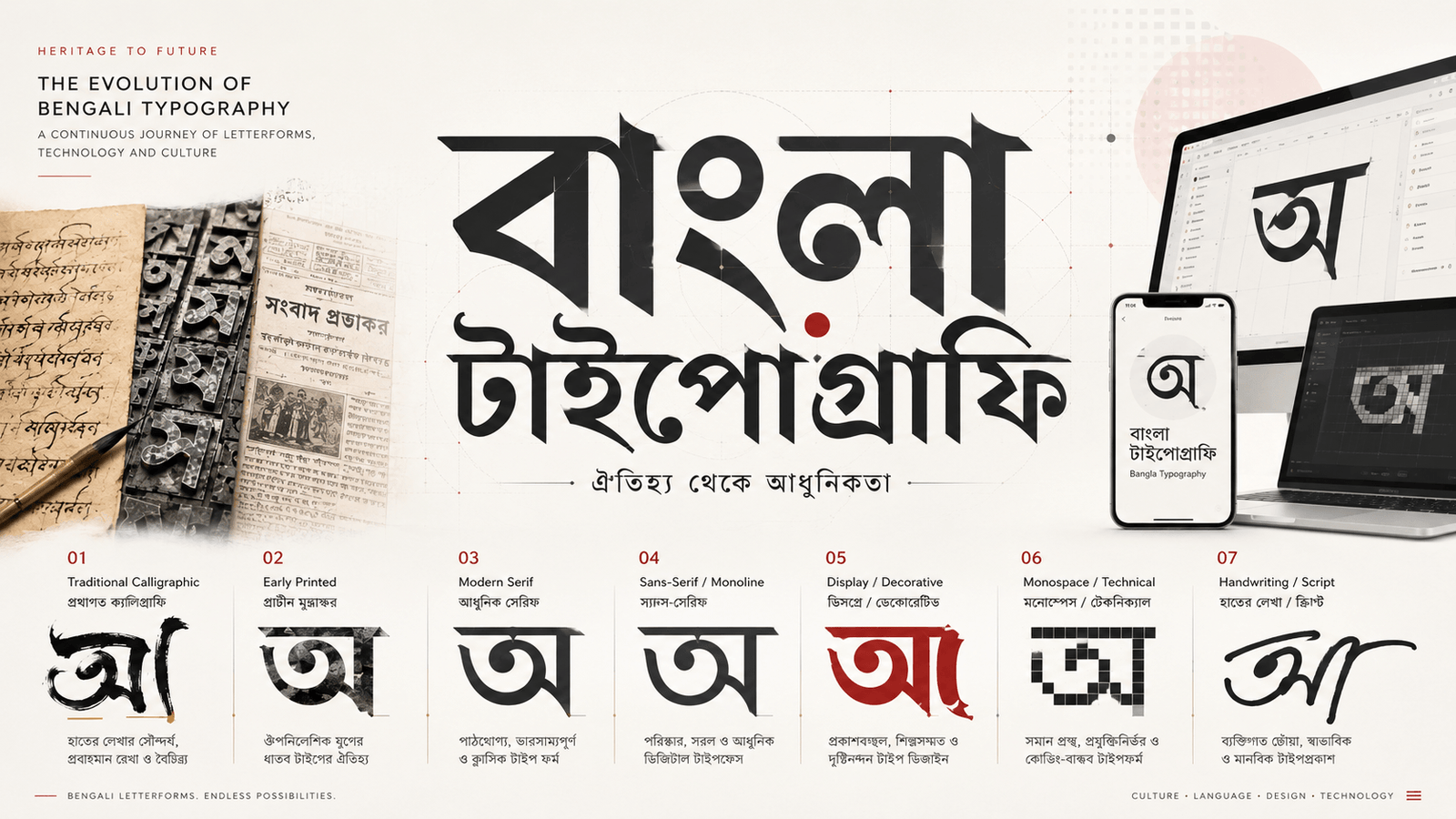
There is no universally accepted official number of Bengali typography styles.
Unlike some Latin type classifications, Bengali typography has developed through a combination of manuscript traditions, calligraphy, printing technology, typefounding, newspaper publishing, advertising, digital typography, and contemporary type design.
For practical study, however, Bengali typography can be organized into seven broad style families:
- Traditional Calligraphic & Manuscript
- Early Printed / Colonial-Era Type
- Modern Serif & Text Typography
- Sans-Serif / Monoline Typography
- Display & Decorative Typography
- Monospace & Technical Typography
- Handwriting & Script Typography
These categories should not be treated as an official historical taxonomy. They are a useful framework for understanding how Bengali letterforms have evolved and how contemporary designers classify and use Bangla typefaces.
The history is particularly interesting because Bengali type design is closely connected to its calligraphic origins. Research into Bengali letterforms has shown that stroke thickness, stroke stress, structural features, conjuncts and other anatomical characteristics play an important role in how Bengali typefaces are designed and perceived.
What Is Bengali Typography?
Bengali typography is the art and practice of designing, arranging, and reproducing Bengali-language text in a visually effective way.
It includes much more than selecting a Bengali font.
Typography considers:
- Letterform construction
- Stroke thickness
- Proportion
- Spacing
- Line height
- Conjunct formation
- Vowel and diacritic positioning
- Headline and body-text hierarchy
- Legibility
- Readability
- Visual rhythm
- Digital text rendering
- Cultural and historical context
Bengali type design is particularly complex because Bengali is an Indic abugida, with consonants, vowel signs, modifiers and conjunct forms interacting within words. Bengali also does not use uppercase and lowercase in the same way as Latin typography. Research on Bengali letterform anatomy has identified numerous structural features and has compared typefaces including Lohit Bengali, Vrinda, SolaimanLipi and Rupali.
The 7 Major Styles of Bengali Typography
1. Traditional Calligraphic & Manuscript Style
Traditional Bengali typography begins with the handwritten form of the script.
Before modern printing technologies, Bengali text was reproduced through manuscript and calligraphic practices. The shapes of letters were influenced by writing tools, materials, stroke movement and the visual conventions of handwritten Bengali.
Key Characteristics
Traditional Bengali calligraphic forms commonly emphasize:
- Flowing strokes
- Curved letterforms
- Variable stroke thickness
- Organic proportions
- Calligraphic rhythm
- Complex conjuncts
- Strong horizontal relationships
- Individual pen or brush characteristics
The relationship between calligraphy and typography remains important even in modern type design. Research into Bengali type anatomy notes that characteristics such as stroke thickness and stroke stress can carry influences from calligraphic practice into typographic form.
Where Is It Used?
Traditional or calligraphic Bengali styles are particularly appropriate for:
- Cultural projects
- Literary publications
- Heritage branding
- Bengali festivals
- Art exhibitions
- Invitations
- Hand-lettering
- Traditional signage
- Editorial illustrations
Why It Matters
This style represents the visual foundation from which later Bengali type traditions developed.
It is therefore more accurate to think of Bengali typography as a continuum from handwriting and calligraphy toward mechanical and digital reproduction rather than as a collection of completely separate styles.
2. Early Printed & Colonial-Era Bengali Type
One of the most important turning points in Bengali typography came with the development of movable Bengali metal type in the late 18th century.
In 1778, Charles Wilkins, with the assistance of Panchanan Karmakar, produced Bengali type for N. B. Halhed's A Grammar of the Bengal Language. Banglapedia identifies this as the first book printed with Bengali alphabet type and describes Wilkins' work as an important milestone in Bengali printing.
This was more than a technological development.
It transformed handwritten letterforms into repeatable typographic characters.
Key Characteristics
Early printed Bengali type was influenced by:
- Existing handwritten forms
- Engraving techniques
- Metal type manufacturing
- Printing limitations
- Conjunct construction
- Stroke contrast
- Reproducibility
The transition from manuscript to movable type therefore changed not only how Bengali was printed, but also how its letterforms could be designed.
Important Historical Milestone
1778 — Bengali movable type
Charles Wilkins and Panchanan Karmakar's work established one of the foundational moments in the history of printed Bengali typography.
Why It Matters
The development of Bengali movable type created the technological foundation for the growth of Bengali books, newspapers and publishing.
Fiona Ross's historical research specifically traces Bengali printed character development from movable metal type through mechanical composition and ultimately digital photocomposition, showing how printing technology influenced the appearance of Bengali typography over two centuries.
3. Modern Serif & Text Typography
As Bengali publishing expanded, type designers developed forms intended for continuous reading in books, newspapers and other publications.
Modern Bengali serif and text faces generally prioritize:
- Legibility
- Readability
- Consistent rhythm
- Controlled stroke contrast
- Comfortable spacing
- Efficient composition
- Clear conjunct rendering
This category includes many Bengali typefaces designed primarily for editorial and long-form text.
Examples
Representative examples include:
- Adobe Bengali
- Noto Serif Bengali
- SolaimanLipi
- Rupali
- Vrinda
- Linotype Bengali
These examples are not identical stylistically. They demonstrate the broad range of Bengali text typography.
For example, Adobe Bengali was designed by Neelakash Kshetrimayum with Fiona Ross consulting. Adobe describes its construction as being based on traditional Bengali calligraphy, with relatively controlled contrast intended to preserve strong, legible forms at small sizes.
Best Uses
Modern Bengali serif typography works especially well for:
- Books
- Newspapers
- Magazines
- Articles
- Academic publications
- Long-form websites
- Editorial design
- Literature
4. Sans-Serif & Monoline Bengali Typography
The growth of computers, websites, smartphones and user interfaces created new requirements for Bengali typography.
This encouraged the development and wider adoption of cleaner, more uniform Bengali typefaces.
Sans-serif or monoline designs generally reduce traditional stroke contrast and emphasize a more contemporary visual appearance.
Key Characteristics
Common characteristics include:
- More consistent stroke weight
- Cleaner forms
- Reduced contrast
- Modern proportions
- Screen-oriented construction
- Strong UI readability
- Contemporary visual personality
Popular Examples
Examples include:
- Noto Sans Bengali
- Mukta
- Lohit Bengali
- Hind Siliguri
- Anek Bangla
- Kohinoor Bangla
Current font libraries demonstrate the breadth of contemporary Bengali sans-serif design. Adobe Fonts, for example, lists families such as Noto Sans Bengali, Hind Siliguri, Anek Bangla and Kohinoor Bangla alongside serif and display-oriented Bengali families.
Noto Sans Bengali
Noto Sans Bengali is part of Google's Noto project and is available in a wide range of weights and widths, making it suitable for interfaces, websites and other contemporary applications.
Best Uses
Sans-serif Bengali fonts are particularly useful for:
- Websites
- Mobile applications
- UI/UX design
- Corporate branding
- Presentations
- Social media graphics
- Digital advertising
- Modern editorial design
5. Display & Decorative Bengali Typography
Not every Bengali typeface is designed for paragraphs.
Display typography is created primarily to attract attention.
Display and decorative Bengali typefaces can experiment with:
- Unusual proportions
- Heavy strokes
- Decorative terminals
- Geometric forms
- Organic shapes
- Experimental constructions
- Poster-style lettering
- Cultural motifs
These designs may not be ideal for long paragraphs, but they can be extremely effective when visual impact is the priority.
Common Applications
Display Bengali typography is often appropriate for:
- Posters
- Event branding
- Film titles
- Festival graphics
- Packaging
- Advertising
- Logo design
- Editorial covers
- Social media campaigns
A Important Principle
A display typeface should not automatically be judged by the same criteria as a body-text typeface.
A headline may need personality and visual impact, while a paragraph needs comfort and sustained readability.
6. Monospace & Technical Bengali Typography
Digital technology introduced another requirement: Bengali text sometimes needs to work inside systems where characters occupy fixed or controlled widths.
This creates a smaller but useful category of monospace and technical typography.
Characteristics
Technical Bengali typefaces may prioritize:
- Consistent character width
- Predictable spacing
- Screen rendering
- Coding environments
- Tables
- Technical interfaces
- Data presentation
This is not one of the dominant Bengali typography traditions, particularly for conventional editorial text. Instead, it represents a functional category created largely by digital requirements.
Where It Can Be Used
- Code editors
- Technical interfaces
- Digital terminals
- Data tables
- Software interfaces
- Experimental typography
The important point is that monospace describes a typographic function, not necessarily a historical Bengali tradition.
7. Handwriting & Script Typography
The seventh category includes contemporary Bengali fonts designed to imitate handwriting, brush lettering or expressive calligraphy.
These typefaces attempt to reproduce the personality of handwritten text while providing the convenience of digital typography.
Characteristics
They may feature:
- Irregular stroke movement
- Connected-looking forms
- Brush-like details
- Expressive proportions
- Decorative terminals
- Informal rhythm
- Personal visual character
Common Uses
Handwriting-style Bengali fonts can work well for:
- Invitations
- Greeting cards
- Social media artwork
- Children's publications
- Cultural campaigns
- Food packaging
- Personal branding
- Creative posters
However, because handwritten Bengali can vary significantly between writers, there is no single universal "Bengali handwriting style."
Bengali Typography Styles at a Glance
| Style | Main Character | Typical Use |
|---|---|---|
| Traditional Calligraphic | Organic, handwritten, expressive | Cultural work, art, heritage |
| Early Printed / Colonial | Calligraphy adapted to metal type | Historical printing |
| Modern Serif | Readable, structured, controlled contrast | Books, newspapers, editorial |
| Sans-Serif / Monoline | Clean, contemporary, uniform | Web, UI, branding |
| Display / Decorative | Bold, expressive, experimental | Posters, advertising, titles |
| Monospace / Technical | Fixed-width, functional | Software, technical layouts |
| Handwriting / Script | Personal, informal, expressive | Invitations, creative graphics |
Why Isn't There a Fixed Number of Bengali Typography Styles?
This is perhaps the most important question.
If someone asks, "Exactly how many Bengali typography styles are there?", the most accurate answer is:
There is no universally accepted official number of Bengali typography styles.
The reason is that "style" can mean different things.
For example, a researcher may classify Bengali typefaces according to:
- Historical period
- Serif characteristics
- Stroke contrast
- Calligraphic origin
- Printing technology
- Intended application
- Regional practice
- Typeface anatomy
- Digital functionality
- Visual personality
One classification might therefore contain only serif and sans-serif, while another might divide Bengali type into many more detailed categories.
This is why the seven-family framework used in this article should be understood as a practical design and research framework—not a formal standard.
Bengali Typography Is More Complex Than Serif vs. Sans-Serif
It is tempting to simply apply Western typography classifications to Bengali.
But Bengali script has its own structural characteristics.
Research into Bengali letterforms has examined features such as:
- Stems
- Bowls
- Curves
- Terminals
- Loops
- Structural relationships
- Stroke thickness
- Stroke stress
- Diacritics
- Conjuncts
The research also demonstrates that different Bengali typefaces can vary significantly in their structural treatment of these features.
Therefore, describing a Bengali typeface simply as "serif" or "sans-serif" can sometimes hide important details about its actual construction.
What Makes Bengali Typography Different From Latin Typography?
Bengali typography shares some general principles with Latin typography, but the script introduces its own design challenges.
1. The Matra
The horizontal headline-like structure across Bengali characters strongly influences the visual rhythm of words.
2. Conjuncts
Bengali uses numerous conjunct forms in which consonants combine into complex visual structures.
3. Vowel Signs
Vowel signs can appear in positions around consonant structures, creating different spatial requirements.
4. No Uppercase/Lowercase System
Bengali does not have the conventional uppercase/lowercase distinction found in Latin typography.
5. Complex Glyph Positioning
Digital Bengali typography requires sophisticated shaping and positioning so that characters, vowel signs and conjuncts appear correctly.
Modern Bengali typefaces therefore depend heavily on Unicode encoding and OpenType shaping technology. Adobe's documentation for Adobe Bengali specifically notes Unicode support, OpenType layout and extensive conjunct handling.
Bengali Typography History: A Simple Timeline
Before Modern Printing — Manuscript & Calligraphy
Bengali letterforms developed through handwritten traditions and the tools and materials used to reproduce them.
1778 — Bengali Movable Type
Charles Wilkins, working with Panchanan Karmakar, produced Bengali type used in N. B. Halhed's A Grammar of the Bengal Language. This is a foundational milestone in printed Bengali typography.
Early 19th Century — Expansion of Bengali Printing
Bengali printing expanded through missionary presses, publishing and newspapers.
Samachar Darpan began publication at Serampore in 1818, becoming an important milestone in the history of Bengali-language print culture.
19th–20th Century — Mechanical Printing & Publishing
As Bengali publishing developed, type manufacturing and composition technologies continued to change.
This period saw Bengali typography move increasingly from craft-based type production toward industrial publishing.
Fiona Ross's historical work examines this evolution through movable metal type, mechanical typefounding and composition, and later photocomposition.
Late 20th Century — Phototypesetting & Digital Transition
Phototypesetting and digital technologies changed how Bengali typefaces could be produced, stored and composed.
This reduced many of the physical constraints associated with metal type.
21st Century — Unicode, Web & Mobile Typography
Today, Bengali typography exists across:
- Websites
- Smartphones
- Social media
- Digital publishing
- Mobile applications
- Streaming platforms
- Branding
- UI/UX systems
- Digital advertising
The contemporary Bengali type ecosystem includes both traditional-inspired text families and modern sans-serif, display and variable-font approaches.
Bangladesh and West Bengal: Are the Typography Styles Different?
Bengali typography developed across multiple geographic and publishing environments, particularly in Bangladesh and West Bengal.
However, it would be misleading to claim that Bangladesh has exactly one Bengali typography style and West Bengal has another.
The differences are better understood through:
- Publishing history
- Newspaper traditions
- Type foundries
- Local designers
- Government and institutional usage
- Software ecosystems
- Cultural preferences
- Font availability
In other words, regional influence exists, but it should not be reduced to a rigid two-style classification.
The shared Bengali script creates a common typographic foundation, while different publishing cultures have contributed their own visual preferences.
Important Bengali Typography Designers and Historical Figures
The history of Bengali typography includes both historical type makers and modern type designers.
Charles Wilkins
Wilkins played a foundational role in developing early Bengali movable type in the 18th century.
Panchanan Karmakar
Panchanan Karmakar was an important Indian type maker associated with the development of early Bengali metal type alongside Wilkins.
Fiona Ross
Fiona Ross is an important scholar and type specialist whose research has documented the evolution of printed Bengali characters and the development of Bengali type from metal type to digital technologies.
Neelakash Kshetrimayum
Neelakash Kshetrimayum designed Adobe Bengali, with Fiona Ross consulting on the project. The design connects contemporary digital typography with traditional Bengali calligraphic forms.
Contemporary Type Designers
Modern Bengali typography continues to evolve through the work of designers and type foundries producing families such as:
- Noto Sans Bengali
- Noto Serif Bengali
- Mukta
- Hind Siliguri
- Anek Bangla
- Kohinoor Bangla
- Tiro Bangla
- Sarvatrik Bangla
The growing number of contemporary families demonstrates that Bengali typography is an active design field rather than a historical artifact.
How to Choose the Right Bengali Typography Style
The best Bengali font depends on the purpose of the design.
| Design Requirement | Recommended Style |
|---|---|
| Long article | Modern Serif / Text |
| Printed book | Serif / Text |
| Newspaper | Text-oriented serif |
| Website UI | Sans-serif |
| Mobile app | Sans-serif |
| Corporate identity | Sans-serif or distinctive display |
| Cultural branding | Calligraphic or display |
| Poster | Display / Decorative |
| Festival campaign | Display / Handwriting |
| Invitation | Handwriting / Calligraphic |
| Technical interface | Monospace / Technical |
The key principle is simple:
Choose typography based on communication goals, not merely visual attractiveness.
A beautiful display font may look excellent in a headline but become difficult to read in a 1,000-word article.
Bengali Typography for Designers: What Should You Look For?
If you are a graphic designer, brand designer or UI/UX designer working with Bengali typography, examine more than the font name.
Look closely at:
1. Stroke Contrast
How different are thick and thin strokes?
2. Letter Proportion
Are the characters wide, narrow, compact or spacious?
3. Matra Treatment
How does the typeface handle the horizontal structure of Bengali words?
4. Conjunct Design
Are complex conjuncts readable and visually consistent?
5. Vowel Sign Placement
Do vowel signs remain clear at different sizes?
6. Spacing
Does the font maintain a comfortable rhythm between characters and words?
7. Weight
Does the typeface remain readable when bold or at small sizes?
8. Digital Rendering
Does it perform well across browsers, operating systems and mobile devices?
9. Personality
Does the font communicate the right cultural and emotional tone?
The Future of Bengali Typography
Bengali typography is moving into an increasingly digital and global design environment.
Contemporary type designers are no longer designing only for printed newspapers and books.
They are designing for:
- Responsive websites
- Smartphone screens
- Social media
- Digital products
- Variable fonts
- Branding systems
- Video
- Gaming
- International multilingual products
This creates an interesting design challenge.
The future of Bengali typography will need to balance heritage and innovation.
Traditional calligraphic structures remain an important source of inspiration, while contemporary designers continue to explore cleaner, more flexible and technologically sophisticated forms.
So, How Many Bengali Typography Styles Are There?
If you need a short answer:
There is no officially standardized number of Bengali typography styles. However, for practical design and research purposes, Bengali typography can be organized into seven broad families: traditional calligraphic/manuscript, early printed/colonial, modern serif, sans-serif/monoline, display/decorative, monospace/technical, and handwriting/script.
These seven categories should be understood as a working classification, not a definitive historical standard.
The history of Bengali typography is better understood as an evolving continuum—from handwritten and calligraphic forms, through movable metal type and mechanical printing, to phototypesetting, Unicode and today's digital typefaces. Fiona Ross's historical research particularly emphasizes this technological and visual evolution.
Frequently Asked Questions About Bengali Typography
1. How many Bengali typography styles are there?
There is no universally accepted official number. A practical framework can group Bengali typography into seven broad families: calligraphic/manuscript, early printed, modern serif, sans-serif, display/decorative, monospace/technical, and handwriting/script.
2. What is Bengali typography?
Bengali typography is the design and arrangement of Bengali text for communication. It includes typeface design, letterform construction, spacing, conjuncts, vowel signs, hierarchy, readability and digital text rendering.
3. What is the oldest Bengali typography style?
The oldest tradition is rooted in handwritten and calligraphic Bengali forms. The history of printed Bengali typography begins much later, with the development of Bengali movable type in the 18th century.
4. When did Bengali printing begin?
A major milestone occurred in 1778, when Bengali movable type associated with Charles Wilkins and Panchanan Karmakar was used for N. B. Halhed's A Grammar of the Bengal Language.
5. What is the difference between Bengali calligraphy and Bengali typography?
Calligraphy is generally created through individual handwritten or drawn strokes, while typography uses designed and repeatable letterforms to compose text consistently.
6. What are Bengali serif fonts?
Bengali serif or text-oriented fonts generally use more pronounced stroke modulation or terminal characteristics and are commonly designed for books, newspapers and continuous reading.
7. What are Bengali sans-serif fonts?
Bengali sans-serif fonts generally use cleaner forms and reduced stroke contrast. They are particularly common in digital interfaces, websites, applications and contemporary branding.
8. Why is Bengali type design difficult?
Bengali includes complex conjuncts, vowel signs, modifiers and contextual shaping. Designers must maintain visual rhythm and legibility while ensuring that the typeface works correctly in digital text systems.
9. What are some popular modern Bengali fonts?
Examples include Noto Sans Bengali, Noto Serif Bengali, Mukta, Lohit Bengali, Hind Siliguri, Anek Bangla, Tiro Bangla and Kohinoor Bangla. Contemporary font libraries contain many additional Bengali families.
10. Is Bengali typography the same in Bangladesh and West Bengal?
The underlying script is shared, but publishing traditions, design preferences, typefaces and institutional practices can differ. It is more accurate to discuss regional tendencies than to claim two completely separate Bengali typography systems.
Final Thoughts
Bengali typography is not a fixed collection of seven fonts—or even seven officially recognized styles.
It is a living design tradition.
Its visual language has evolved from handwriting and calligraphy to metal type, industrial printing, newspapers, phototypesetting, desktop publishing, Unicode, websites and smartphones.
The seven-style framework presented here provides a useful way to understand that evolution:
- Traditional Calligraphic & Manuscript
- Early Printed / Colonial-Era
- Modern Serif & Text
- Sans-Serif / Monoline
- Display & Decorative
- Monospace & Technical
- Handwriting & Script
For designers, the most important lesson is not memorizing a number.
It is understanding why Bengali letterforms look the way they do, how their structure has evolved, and how different typographic choices affect readability, personality and cultural expression.
Bengali typography has already travelled from the manuscript page to the metal type case and from the printing press to the smartphone screen.
Its next chapter is still being designed.
Suggested Internal-Link Opportunities
If this article is part of a larger design or typography website, consider linking to related content such as:
- Bengali font selection guide
- Bengali calligraphy guide
- Typography basics for graphic designers
- Serif vs. sans-serif typography
- Bengali logo design
- Bengali branding typography
- Best Bengali fonts for websites
- Bengali font pairing guide
- Bengali typography anatomy
- History of Bengali printing
- Unicode Bengali fonts
- Bengali typeface design tutorial
Recommended Visual Assets
For a visually rich version of this article, consider adding:
- Hero Image: Seven Bengali typography styles presented as a sophisticated typographic specimen.
- Historical Graphic: 1778 Bengali movable type and the transition from manuscript to printing.
- Comparison Graphic: Serif vs. sans-serif Bengali letterforms.
- Typography Anatomy Diagram: Bengali letterform showing matra, stem, bowl, vowel signs and conjunct structures.
- Timeline: Manuscript → 1778 metal type → 19th-century printing → phototypesetting → digital fonts → Unicode/web/mobile.
- Font Specimen: Contemporary Bengali typefaces shown side by side.
- Designer Guide: Which Bengali typography style to choose for books, websites, branding, posters and UI.
Important: Historical artifacts should be clearly identified as authentic historical specimens, reproductions, or modern recreations rather than presented interchangeably.
Sources & Further Reading
- Fiona Ross, The Printed Bengali Character and Its Evolution — a major historical study of Bengali type development.
- Fiona Ross, The Evolution of the Printed Bengali Character from 1778 to 1978 — research tracing Bengali typography from movable metal type to digital photocomposition.
- Subhajit Chandra, Prasad Bokil & Udaya Kumar Dharmalingam, Anatomy of Bengali Letterforms: A Semiotic Study — research examining Bengali letterform structure and comparing typefaces including Lohit Bengali, Vrinda, SolaimanLipi and Rupali.
- Adobe Fonts — Adobe Bengali documentation and contemporary Bengali font families.
- Banglapedia — historical information on Charles Wilkins and the development of Bengali printing.
SEO / GEO / AEO Summary
Primary search question: How many styles exist in Bengali typography?
Direct answer: There is no universally accepted official number of Bengali typography styles. For practical classification, they can be grouped into seven broad families: calligraphic/manuscript, early printed, modern serif, sans-serif, display/decorative, monospace/technical, and handwriting/script.
Related questions this article answers:
- What is Bengali typography?
- How many Bengali typography styles are there?
- What are the major Bengali font styles?
- What is the history of Bengali typography?
- Who created the first Bengali typeface?
- When did Bengali printing begin?
- What are Bengali serif fonts?
- What are Bengali sans-serif fonts?
- Why is Bengali type design complex?
- What are the best Bengali typography styles for branding?
- How is Bengali typography different from Latin typography?
- Is Bengali typography different in Bangladesh and West Bengal?


Share Your Thoughts
Your email won't be published. We welcome your feedback, questions, or suggestions.